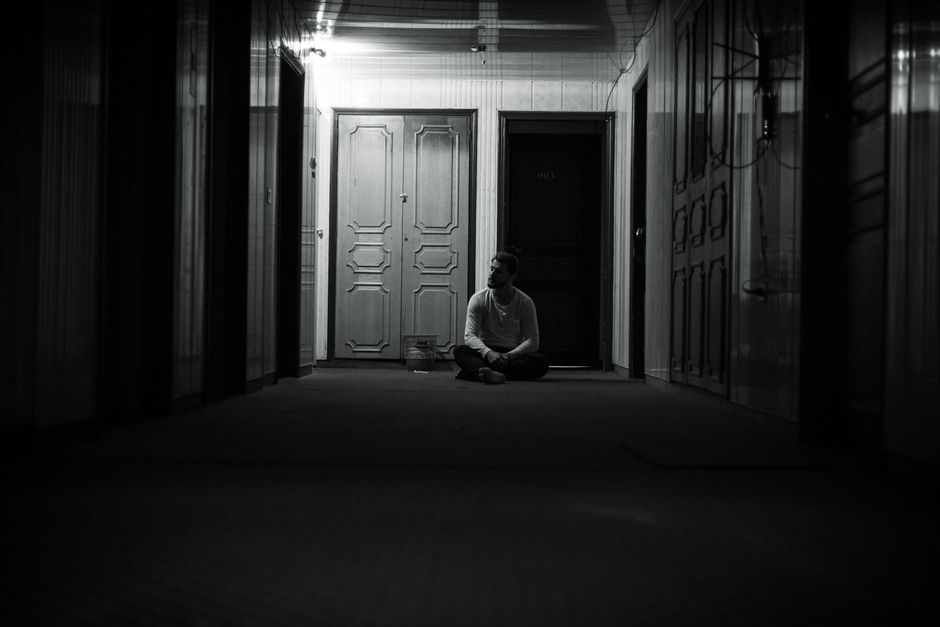
Why Can’t I Cry — and What Does It Mean for Emotional Release?
If you have ever wondered “why can’t I cry,” you are not alone. Many adults struggle with crying inhibition — the inability to release tears even when they feel deeply sad, frustrated, or overwhelmed. Somatic therapists say this disconnect between emotion and expression often traces back to early experiences that taught us crying was unsafe or unacceptable. Understanding this pattern is the first step toward reclaiming your capacity for emotional release.
In this article, we explore what happens in your body when tears get stuck, why somatic awareness matters for emotional health, and gentle practices that can help you reconnect with this deeply human form of release — without forcing anything before you are ready.
The Moment You Might Recognize
It happens at unexpected times. You are watching a film and everyone around you is reaching for tissues, but your eyes stay dry. Or you receive difficult news — a loss, a disappointment, a betrayal — and you feel the weight of it pressing against your chest, but nothing comes. You might excuse yourself to the bathroom, hoping privacy will loosen something. It does not.
Later, alone in bed, you replay the moment. You felt the sadness. You know it was real. But somewhere between the feeling and the expression, a door closed. You could not access the tears. And that absence — that strange emptiness where release should have been — leaves you feeling more alone than the original pain did.
If this sounds familiar, your body is not broken. It is protecting you in the only way it learned how.
Why Do I Feel Numb Instead of Crying?
One of the most common questions people bring to therapy is some version of this: why do I feel numb instead of crying? They describe a sense of emotional flatness, a heaviness that never quite breaks into tears. Some worry it means they do not care enough. Others fear something is fundamentally wrong with their capacity to feel.
The truth is more compassionate than that. Crying inhibition is not a character flaw or a sign of emotional deficiency. It is a learned pattern, often rooted in childhood, where the nervous system adapted to an environment that did not welcome tears. Perhaps a parent said “stop crying or I will give you something to cry about.” Perhaps the household simply never modeled emotional expression. Perhaps you learned that being “the strong one” was the only way to feel safe or valued.
Over time, these early messages become wired into the body. The throat tightens. The jaw clenches. The chest braces. These physical patterns — what somatic therapists call armoring — become so familiar that we stop noticing them. We just know that tears do not come, and we assume that is who we are.
What Somatic Therapists Actually Say About Crying Inhibition
Somatic therapy approaches emotional release not through the mind alone, but through the body. Where traditional talk therapy might ask “what are you feeling,” a somatic therapist is more likely to ask “where do you feel it” — and then gently guide you toward staying with that sensation rather than analyzing it away.
“Tears are not just an emotional event — they are a physiological process. When we cannot cry, it often means the body has learned to interrupt its own release cycle. The muscles around the eyes, throat, and diaphragm contract to hold the tears in. Our work is not to force tears out, but to help the body remember that it is safe to let go.”
This perspective from somatic therapy reframes crying inhibition entirely. It is not that you are emotionally unavailable. It is that your nervous system is still operating under old rules — rules that once kept you safe but now keep you stuck. The body remembers what the mind has forgotten, and it holds those memories in tension patterns, shallow breathing, and chronic tightness.
Somatic awareness — the practice of tuning into physical sensations without judgment — is the bridge between numbness and feeling. It does not require you to perform emotion or force yourself to cry. Instead, it asks you to notice what is already happening beneath the surface: the subtle trembling, the warmth behind your eyes, the heaviness in your chest that you have been ignoring for years.

Practical Ways to Support Emotional Release
If you have been living with crying inhibition for years or even decades, the idea of “learning to cry again” can feel daunting. These practices are not about producing tears on command. They are about slowly, gently creating the conditions where emotional release becomes possible — in whatever form it takes.
1. Practice the Body Scan Without an Agenda
Set aside five minutes in a quiet space. Lie down or sit comfortably and close your eyes. Starting from the top of your head, move your attention slowly through your body — your forehead, your jaw, your throat, your chest, your belly. You are not trying to fix anything. You are simply noticing. Where do you feel tightness? Where do you feel nothing at all? Somatic therapists emphasize that numbness is information too. The areas where you feel least are often the areas holding the most. Over time, this practice builds the somatic awareness that allows your body to trust it is safe to feel.
2. Use Breath to Soften the Holding Patterns
The diaphragm is one of the primary muscles involved in crying inhibition. When it is chronically tight, it restricts the deep breathing that precedes emotional release. Try this: inhale slowly through your nose for four counts, allowing your belly to expand fully. Hold for two counts. Then exhale through your mouth with a gentle sigh — letting the exhale be audible if that feels comfortable. The sigh is important. It activates the vagus nerve and signals to your body that it is safe to soften. Repeat five to ten times. You may notice a tremor in your lips or a warmth behind your eyes. Let it be.
3. Create a “Release-Safe” Environment
Many of us learned to suppress crying in environments that felt unsafe for vulnerability. Reversing this pattern means intentionally creating spaces where emotional expression is welcome. This might mean a specific corner of your home where you sit with music that moves you. It might mean a warm bath where the water holds your body. It might mean writing in a journal and letting yourself be messier on the page than you allow yourself to be in life. The key is consistency — returning to this space regularly, even when nothing dramatic happens. You are teaching your nervous system a new pattern: this is a place where I am allowed to feel.
4. Explore Gentle Movement and Sound
Sometimes the body needs to move before it can release. Somatic practitioners often recommend slow, intuitive movement — rocking, swaying, shaking the hands — as a way to discharge tension that the body has been holding. Adding sound can deepen this process. Humming, sighing, or even placing your hand on your chest and making a low “mmm” sound can vibrate through the tissues of the throat and chest where many people hold their tears. You are not performing grief. You are inviting your body to complete an expression it started long ago.
How Crying Connects to Intimacy and Self-Care
There is a link between our capacity for emotional release and our capacity for intimacy — both with others and with ourselves. When we cannot cry, we often cannot fully relax into closeness either. The same muscular guarding that holds back tears also holds back vulnerability, tenderness, and the deep exhale of letting another person see us as we are.
Somatic therapists note that clients who begin to reconnect with crying often report changes in other areas too: they sleep more deeply, they feel more present during physical touch, they experience a richer range of sensation throughout their bodies. This makes sense. Emotional release is not separate from physical aliveness — it is part of the same spectrum.
Self-care, in this context, is not about bubble baths or scented candles — though those can be lovely. It is about the willingness to be with yourself in the places that feel most uncomfortable. It is about choosing, again and again, to stay rather than shut down. That is a profound act of self-intimacy.
You May Also Like
- How to Actually Relax When You Are Alone
- The Science of Sensory Wellness and Touch Therapy
- After 18 Years, We Relearned Each Other
Tonight’s Invitation
Before you fall asleep tonight, place one hand on your chest and one on your belly. Take three slow breaths and notice what you feel — not what you think you should feel, but what is actually there. If your eyes sting, let them. If your throat tightens, let it. If nothing happens, let that be enough too. You are not failing at feeling. You are practicing the patience it takes to come home to yourself.
A Final Thought
Your relationship with crying is not fixed. It is a living thing, shaped by everything you have been through and everything you are still becoming. If tears have felt far away for a long time, that distance is not permanent. It is a measure of how carefully your body has been protecting you — and how much courage it takes to tell your body that the danger has passed. Wherever you are in that process, you are allowed to go slowly. You are allowed to take up space with your feelings. And you are allowed to discover that emotional release, when it finally comes, is not a sign of weakness. It is the body’s way of saying: I am alive, and I am ready to feel again.